Bring your study
Upload summary statistics or import a file from a public link, including Figshare.
Whole-study association, locus fine-mapping and biological evidence meet in a research workspace built around the questions each method can answer.
Whole-study TSV, CSV, semicolon-separated and gzip sources; GRCh37 or GRCh38, with recorded ancestry.
Upload summary statistics or import a file from a public link, including Figshare.
Review fields and genome build. Discover associated loci and fine-map selected regions.
Compare gene tests, regulatory annotations and molecular evidence in their genomic context.
Review candidates, evidence gaps and methods. Download the study report for your research.
Review the submitted association distribution, significant variants and distance-clumped loci. The result records which regions were selected for fine-mapping.
SuSiE-RSS assigns posterior inclusion probabilities and credible sets using matched linkage disequilibrium. CARMA comparisons retain agreement and sensitivity separately.
Reference matching and usable source columns determine compatibility.ACAT combines variant p-values in gene windows. MAGMA adds an LD-aware association test and competitive gene-set analysis.
The current LD-aware workflow supports compatible European-ancestry GRCh37 and GRCh38 studies.Gene, regulatory and molecular records retain their genome build, tissue context and source. Overlap, colocalization and direct regulation remain separate assessments.
Candidate relationships carry their supporting evidence, alternatives and missing observations. Experimental evidence and independent replication require their own assessments.
Compatible analyses can use Ensembl genes and regulatory annotation, GTEx and eQTL Catalogue molecular evidence, GWAS Catalog context, and pinned pathway resources. Coverage and provider failures remain visible in the result.
Browse public analyses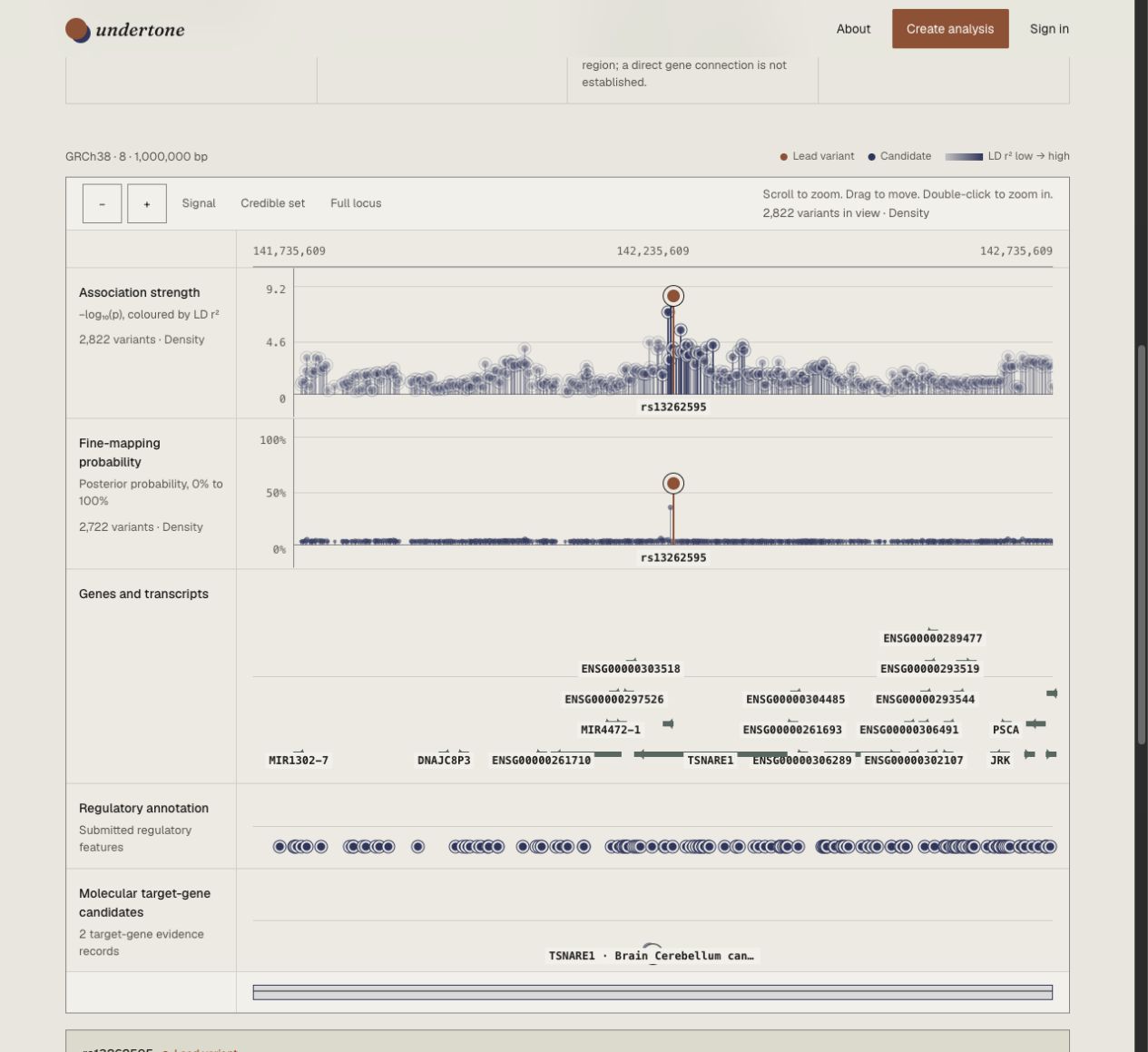
Compare fine-mapped variants and their surrounding regulatory context before selecting a follow-up question.
Read whole-study gene-test ranks alongside locus-level molecular candidates, preserving the distinction between their methods.
Use the browser and downloadable report to discuss evidence, coverage and the remaining experimental work.
Bring a GWAS study. Follow the evidence.